
AGE: Late 60s to age 80
SITUATION: Client with cash value life insurance or cash in the bank considering the purchase of a MYGA (Multi-year Guaranteed Annuity).
TYPE: Non-qualified
OBJECTIVE: Pass funds to beneficiaries efficiently and without investment or interest rate risk. Also, maintaining access to the principal in the event it is needed for unforeseen circumstances.
The Lowdown
As mentioned in our previous article, MYGA products are flying off the shelves in today’s interest rate environment. But, is a MYGA really the best way to pass assets to the next generation? What if the client already has LTC coverage or doesn’t want it?
Non-qualified Assets Already in a Life Insurance Policy or in Cash at the Bank
While MYGA rates remain attractive, there are some risks to moving cash values or cash into a fixed annuity when the objective is to leave the asset to beneficiaries. By considering a single pay life insurance product, many of those pitfalls can be alleviated.
Clients should also consider the 1035 of cash value life insurance into a single pay life insurance policy. This can be attractive for those who no longer wish to pay premiums. In some cases, the existing life policy will offer a “reduced paid up” option (which is where the death benefit is reduced and no more premiums are due for the life of the policy).
A reduced paid up option, if available, needs to be evaluated vs. a single pay policy to determine what’s best for the client.
Like hybrid LTC annuities, there are many single pay life insurance products on the market, however we are highlighting a specific type that has characteristics allowing it to fit our client profile above.
The benefits of these policies are:
- Leverage of the initial premium for death benefit.
- No tax liability on death (death benefit avoids probate and remitted tax-free to the beneficiary).
- Competitive return on the death benefit to life expectancy, when compared to a MYGA.
- Very liberal underwriting. No exams, no medical record requests, and often instant decisions.
- The initial deposit is accessible immediately (ROP) without penalty if surrendered.
- Much higher compensation than a MYGA.
Examples
These products are available nationally by several large, highly rated carriers.
We are again going to use a 70yo non-nicotine female in CO for the purpose of this example. Like the LTC annuity products, she does not need to be the epitome of health as you’ll see later in this article.
Leverage
A 70-year-old female has roughly a 16-year life expectancy. The highest 5 year MYGA rates by top-rated insurers (A or higher) currently sit around 5%.
The inherent risk in the MYGA when left to a non-spouse beneficiary is twofold:
- Reinvestment risk. The client will have to purchase 2 more MYGAs (maybe 3) over their remaining life. There are no guarantees that rates will continue to be as high as they are currently, decreasing the overall total return.
- Taxation risk. A non-spouse is responsible for the taxes of a non-qualified annuity. While NQ stretch still exists, cashing the annuity out is a popular (albeit often foolish) alternative. An alternative that generates a substantial amount of ordinary income tax.
Single pay life policies (at least the ones referenced in this article) are fully guaranteed. You know exactly what your death benefit will be based on the deposit made from the first day the policy is in force. Your major risk with these products is that you live too long and decrease the internal rate of return on the death benefit.
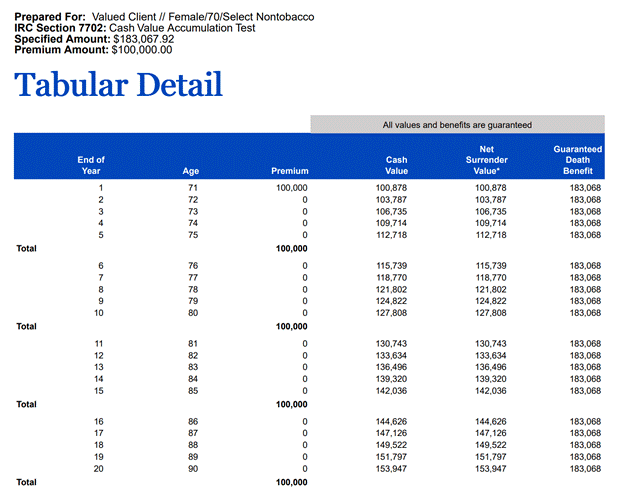
Here is an example of the leverage on a single pay life policy with return of premium for this client:
*You can download the complete illustration HERE
Taxation
Since this is a life policy, the beneficiary will receive the entire death benefit free from both federal and state income taxes.
This is unlike a NQ MYGA, where gains are taxed as ordinary income.
When comparing the two products, the taxation issue can make a single premium life insurance policy very attractive, assuming that the end goal is to use the asset as a legacy.
Growth
Similar to a MYGA, the cash value growth of a single pay life insurance policy is tax deferred. The cash value in a single pay life insurance policy will not appreciate as quickly as the MYGA, however when comparing the taxable balance of a MYGA to the internal rate of return (IRR) on the tax-free death benefit of the life policy, the competition really heats up.
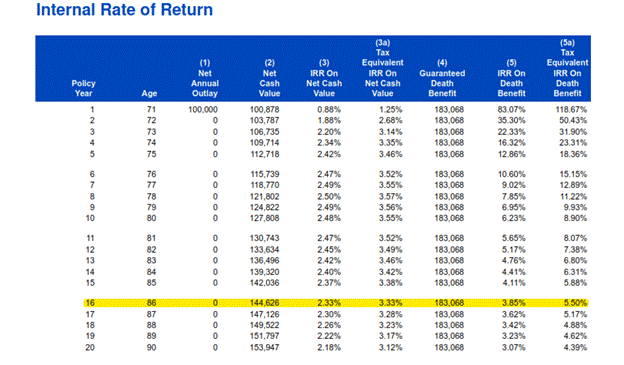
Here is the necessary taxable equivalent return that you’d need to earn in a MYGA to match the IRR of the death benefit in the life policy. This chart shows every year, with our example client’s life expectancy highlighted:
*You can download the complete illustration HERE
As you can see, the taxable-equivalent IRR of the death benefit exceeds the highly rated MYGA market TODAY, not accounting for this hypothetical client needing to reinvest in a product with a similar rate at least 2 more times (see interest rate risk above).
Both the growth and the death benefit of the single pay life insurance policy are fully guaranteed, with the primary risk being the insured surpassing life expectancy.
Underwriting
Sometimes, the decision to choose a MYGA over a life insurance policy with a legacy goal comes down to the client’s health.
Most traditionally underwritten life policies can be difficult to qualify for if the client fits our profile (late 60s to 80).
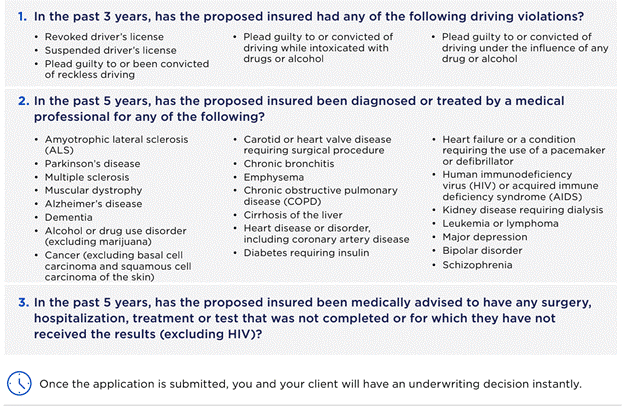
However, these single pay life policies are simplified, not requiring exams or doctor records and having a very simple and liberal application. Below are the health questions in their entirety for one of the top products on the market:
*You can download the product spec sheet with the health questions HERE
That’s it. If you can answer these three questions “no” (honestly of course, they still run prescription history, DMV, and other electronic reports), then you’re approved. The only health classes are standard and standard nicotine.
The above examples all assume non-nicotine.
Extras
Traditional single pay life policies often cannibalize the cash value for the sake of the death benefit. This leaves the client with a “death benefit or nothing” scenario.
These simplified single pay life policies offer a remedy to that issue; They offer a guaranteed return of premium, at any time, should the client wish to surrender the policy.
That is evident from the tabular detail in our first chart. You can see that the guaranteed cash value never drops below the initial deposit. For clients who want peace of mind that if their objectives change or they need the money for an emergency, they can immediately get their deposit back (plus interest if credited).
Conclusion
There are three clients that are ideal for this type of life insurance policy:
- Older people considering purchasing a MYGA with cash/bank assets who “don’t need the money” and want a better rate of return than what their savings account offers.
- People with existing life insurance who no longer wish to pay premiums.
- People who either don’t qualify for an LTC based product or already have LTC.
Single pay life is not a one size fits all solution. There are several products on the market that mimic the examples above. We will help you shop the best carriers for the most lenient underwriting combined with the best/highest guaranteed death benefits.
Our charge as a wholesaler/IMO is to find products and concepts that benefit your clients and benefit your practice. Increase your compensation while increasing your clients’ yield to life expectancy by adding single pay life insurance to your product offerings.
If you’d like to explore how these products can enhance your practice or are curious about any of the points outlined in this article, please contact us today.